

Enki Foundation Discusses the Development Road and Pathways for Sustainable Partnership in Iraqi–Turkish Relations
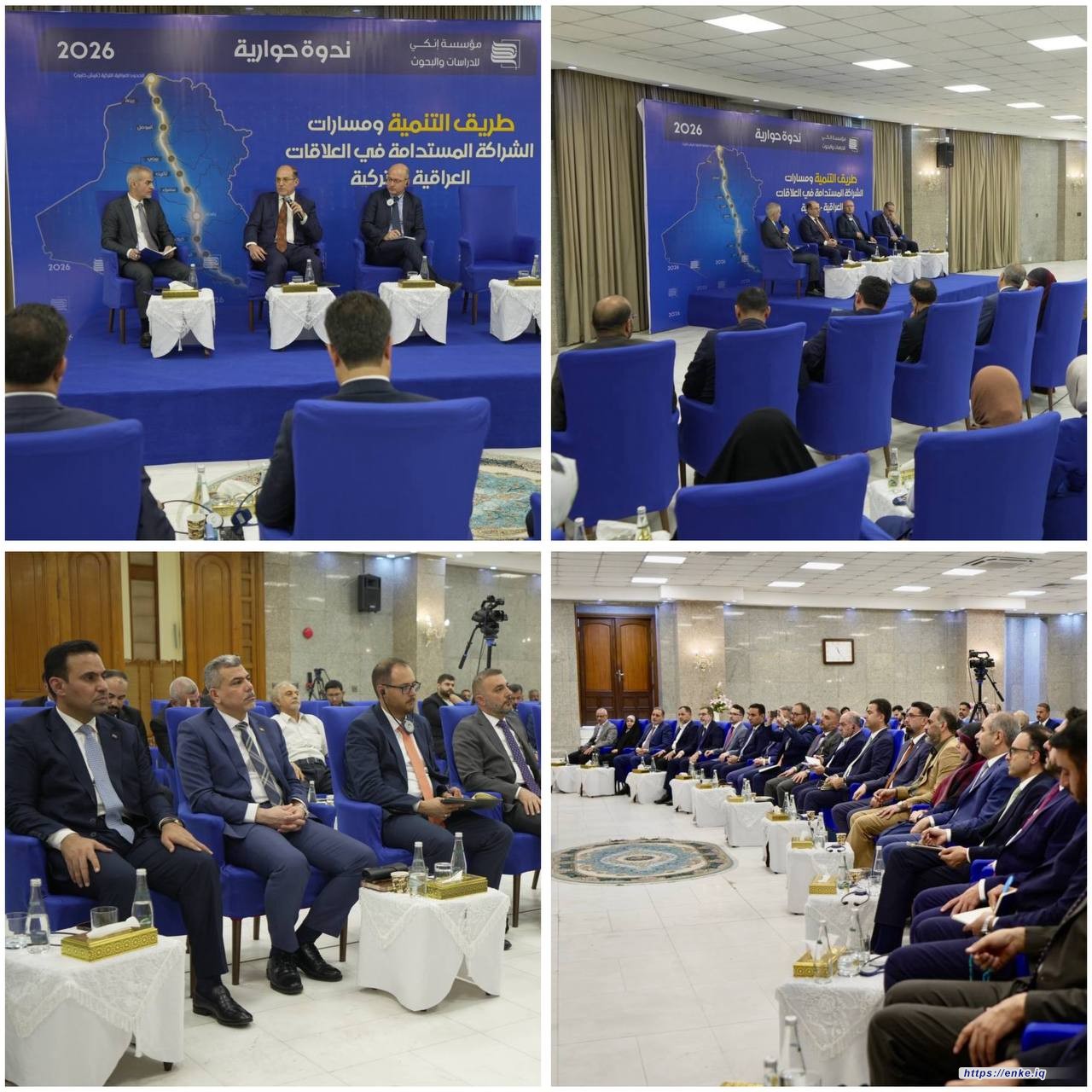
The Enki Foundation for Studies and Research in Baghdad held a dialogue session titled “The Development Road and Pathways for Sustainable Partnership in Iraqi–Turkish Relations,” bringing together a distinguished group of ambassadors and diplomats, a Turkish academic and research delegation, and heads and directors of Iraqi and Turkish research and study centers, alongside university professors, experts, consultants, and economic, commercial, political, and strategic affairs specialists.
The session hosted H.E. Dr. Ahmed Abdul-Zahra Al-Fatlawi, General Coordinator for Provincial Affairs; Dr. Abbas Imran Musa, Director General of the Planning and Follow-up Department at the Ministry of Transport; and Dr. Qadir Temiz, President of the Turkish Center for Middle Eastern Studies (ORSAM). The session was moderated by Dr. Riyadh Al-Zubaidi, Professor of Political Science at Al-Nahrain University.
Dr. Abbas Imran emphasized that the Development Road represents a national project with regional and international dimensions, capable of repositioning Iraq’s geographic location and strengthening its role in international trade. He noted that the project is not limited to transport routes and railways, but encompasses an integrated economic system that includes infrastructure, industrial zones, energy, telecommunications, and logistics services. This would create broad opportunities for the private sector and investment while contributing to the diversification of national income sources.
Imran explained that the project extends for approximately 1,200 kilometers and passes through ten Iraqi provinces. In addition to the road and railway, it includes a fiber-optic cable, oil and gas pipelines, industrial cities, major cargo handling and exchange centers, and projects related to energy and agriculture. He pointed to ongoing technical coordination with the Turkish side regarding the project’s phases and railway connectivity, as well as cooperation with specialized international consulting firms in preparing the project’s designs and economic model.
For his part, Dr. Ahmed Al-Fatlawi addressed the project’s developmental dimensions at the provincial level, noting that its requirements extend from Basra to Nineveh through ten provinces. He identified the key challenge as transforming the provinces along the route from mere transit geography into active partners and direct beneficiaries of the project’s economic and developmental value through economic and industrial cities, energy cities, and accompanying investment projects.
Al-Fatlawi pointed out that the impact of the Development Road is not confined to the economic dimension, but also extends to security, cultural, and social dimensions. He stressed that providing a safe and stable environment is a fundamental factor in attracting investment, while the movement of trade and travelers, along with the openness generated by the project, can contribute to strengthening the economic, social, and cultural conditions of the provinces along its route.
He underscored the importance of Iraq capitalizing on the project beyond its role as a transport and transit corridor, transforming it into an opportunity to strengthen Iraq’s position and regional partnerships, while providing broad space for the private sector to participate in the economic and commercial facilities and activities emerging from the project.
In turn, Dr. Qadir Temiz examined the Development Road project from a geopolitical perspective, emphasizing its strategic importance to both Iraq and Türkiye and its role in connecting Iraq to European markets through Türkiye, thereby enhancing prospects for development, stability, and economic integration between the two countries.
Temiz stressed that security represents the fundamental pillar for the project’s success and for attracting investment, and that achieving stability would contribute to facilitating the movement of people, capital, and services and stimulating markets, ultimately leading to broader economic interconnectedness and integration between Iraq and Türkiye.
He noted that the Development Road could open a new pathway in Iraqi–Turkish relations and provide a broader framework for addressing shared issues between the two countries, including security, water, energy, and development. He emphasized the importance of sustaining cooperation between Baghdad and Ankara and leveraging the project to advance bilateral relations over the long term.
The session featured extensive discussions and specialized interventions addressing the future of the Development Road and its competitiveness among international corridors, its financing sources, and the role of the private sector and domestic and foreign investment. Discussions also covered the readiness of Al-Faw Grand Port and railway connectivity, the distribution of industrial and logistics projects and cities across the provinces, the harmonization of customs procedures, and the legal and institutional frameworks required to ensure the project’s sustainability.
The discussions further addressed geopolitical and security dimensions, water and energy issues, and Iraqi–Turkish relations, as well as the potential for expanding regional participation. Participants also examined the project’s role in creating employment opportunities and stimulating the industrial, agricultural, and services sectors, while stressing the need to ensure that Iraq and the provinces along the route benefit from the project’s added economic value and that Iraq’s role does not remain limited to serving merely as a corridor for the transportation of goods.