Future prospects for the followers of Ahl al-Bayt peace be upon them
A scientific conference aimed at building and improving work and communication networks, and achieving cohesion and rapprochement between the followers of Ahl al-Bayt
Researchers from around the world participate in it
The first edition of it was held in Baghdad on (2-4/2/2023)
Preparatory workshops for the Future Horizons Conference held on 2/14/15/16/2022
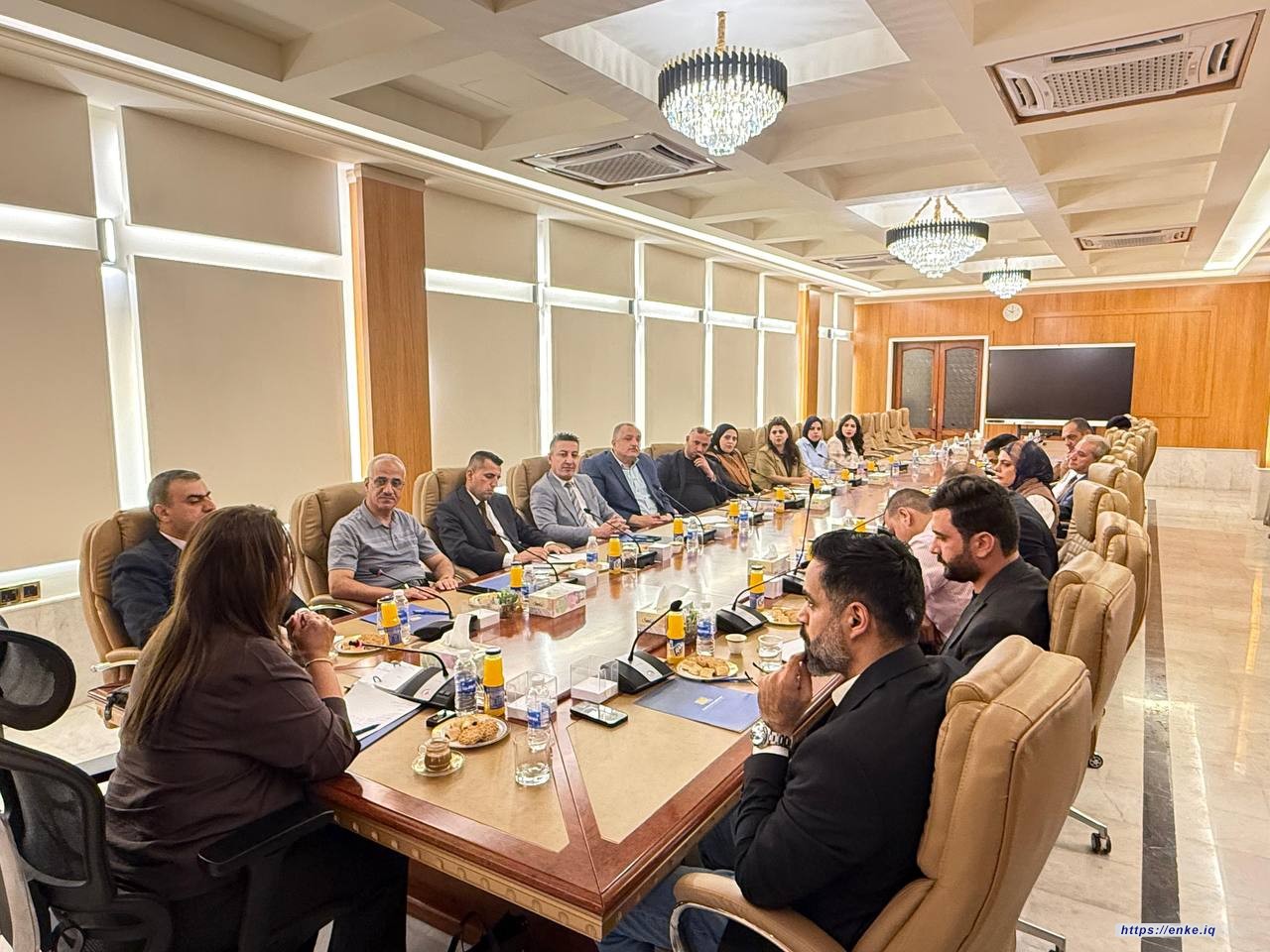
On February 15, 16, 2022, the Anki Foundation held a group of workshops in Baghdad with the participation of the preparatory committee and the scientific committee of the project for three continuous days, which concluded with a meeting with His Eminence Mr. Ammar al-Hakim (may his glory be long) and listening to a brief explanation of the project and its desired goals.
The extensive discussions resulted in an agreement on the date of holding the first conference of the project (Future Prospects for Followers of the People of the House, peace be upon them), and identifying the topics and workshops that will be discussed and the most prominent scientific and religious figures who will be invited to participate.
The first edition of the conference was held coinciding with the anniversary of the birth of the Commander of the Faithful (peace be upon him) in the month of Rajab of the year (1443 AH/2023 AD), with the participation of researchers from various continents of the world.
Meeting of the sponsor of the conference, Hujjat al-Islam wal-Muslimeen, His Eminence Sayyid Ammar al-Hakim, with the preparatory committee after preparing the proposed program for the conference on future prospects for followers of the Ahl al-Bayt, peace be upon them.
Future prospects for the followers of Ahl al-Bayt peace be upon them
A scientific conference aimed at building and improving work and communication networks, and achieving cohesion and rapprochement between the followers of Ahl al-Bayt
Researchers from around the world participate in it
The first edition of it was held in Baghdad on (2-4/2/2023)
Articles
Research Workshops
Research workshops.
First: A workshop on the concept of citizenship within the thought of the People of the House (peace be upon them) / Workshop management: His Eminence Sheikh Ahmed Salman Al-Ahmadi
Shiites in the diaspora: His Eminence Sheikh Abdel Moneim Al-Zein
Second: Workshop on followers of Ahl al-Bayt (peace be upon them) / The first session moderated by: Dr. Hassan Ahmadian / The second session moderated by: Dr. Muhammad Sagha
Sovereignty belongs to God: Reflections on the concept and application of the idea of divine sovereignty from a Shiite Islamic perspective: Dr. Patricia Simone de Prado
The strategic economic plan for developing the Shiite economy in the world: Professor Odeh Mahawish Al-Daja
Sixth: A central and pivotal workshop on the authority of Najaf Al-Ashraf and its possessions for the followers of the People of the House, peace be upon them / Workshop management: Dr. Abbas Kazem
The role of religious authority in the new international order and the extent of its political influence after the fall of the Iraqi regime: Professor Shahad Dashti
The authority’s approach to dealing with international events and homelands: His Eminence Sayyid Ihsan al-Hakim
Morning Session
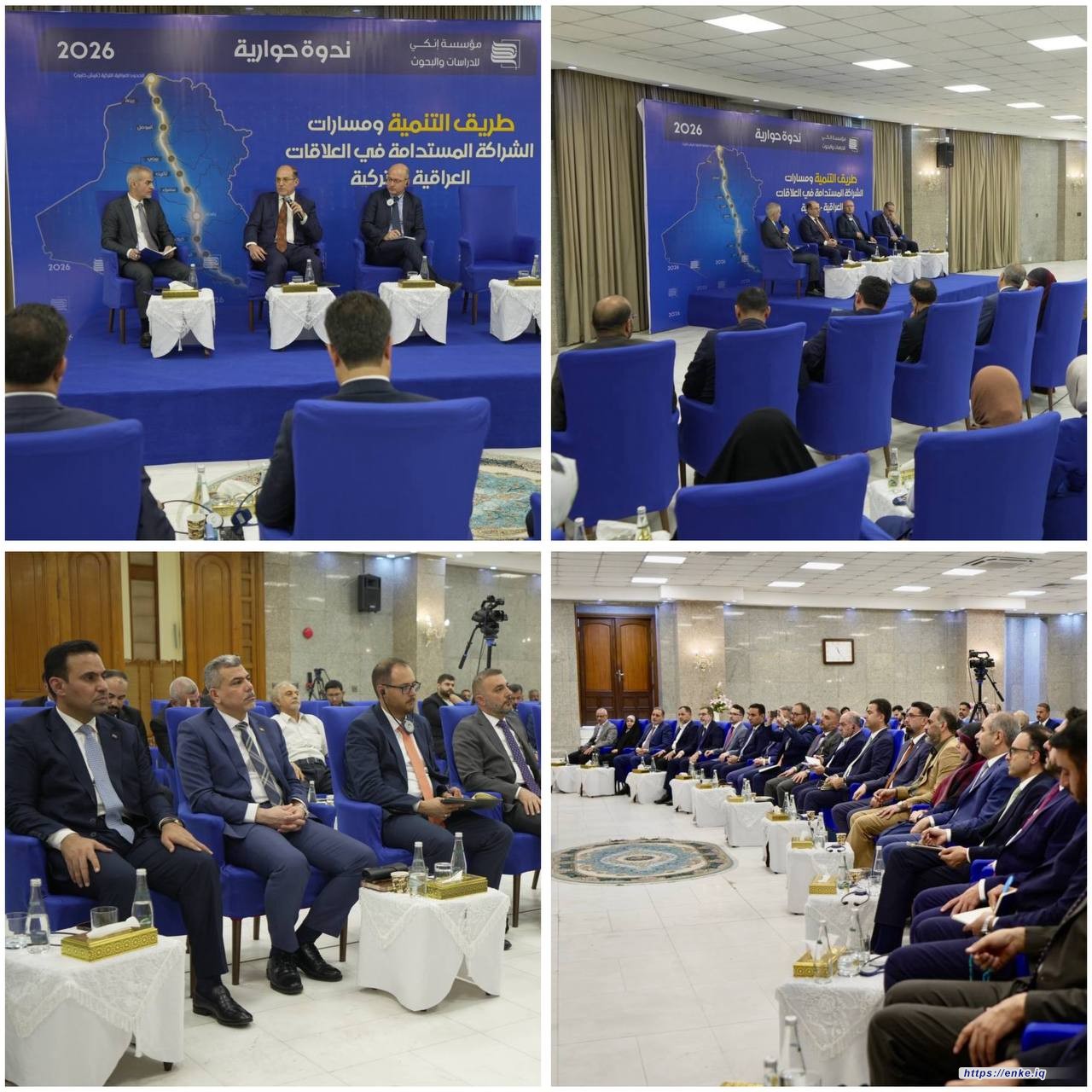
Proceedings of the morning session of the Future Prospects Conference for the Followers of Ahl al-Bayt (peace be upon them).
1- A speech by the Anki Foundation for Studies and Research. 2- Recommendations of the Future Prospects Conference for the followers of Ahl al-Bayt (peace be upon them).
- A speech from the Anki Foundation for Studies and Research.
A speech by the Enki Foundation for Studies and Research delivered by Dr. Zuhair Al-Arnaouti
In the name of God, the most gracious, the most merciful
Praise be to God for what He has bestowed, and thanks be to Him for what He has inspired, and praise for what He has given, of the generality of the blessings He has initiated, the fulfillment of the blessings He has bestowed, and the completion of those He has given. His number is too numerous to count, its duration is far from reward, and its eternity is beyond realization. He enjoined them to increase it with gratitude for its continuity.
Then the blessings be upon the chosen one as long as it appears
The sun of the day and the moon does not shine
Then peace be upon the Lord, his successor
Whoever rises up after him for the religion will be victorious.
I mean Ali with his two sons and their mother
The people of clothing, as the news has come to us
Then peace be upon all of the lights
The son of Hussein and those who were famous for their infallibility
O honorable gathering of gentlemen, sheikhs, scholars, distinguished scholars, academics, and dear guests coming from various continents of the world, may God’s peace, mercy, and blessings be upon you.
It is a source of joy, happiness, delight and elation that your blessed gathering is gathered in the country of the Commander of the Faithful, the country of the prophets, saints and righteous people, specifically in Baghdad, the two important imams Al-Kadhim and Al-Jawad (peace be upon them), and in the presence of His Eminence the Wise Master (may his glory be long), and our young institution, the Enki Foundation for Studies and Research. , which bears the name of the God of wisdom in our ancient civilization, to advance to the horizons of a bright future, God willing.
The place is Iraq, and it has enough of a name to be proud of. Baghdad is the garden of two shining planets from the stars of Doha Muhammadiyah, and halls that have always brought together Iraqis from their various components in the pursuit of goodness and righteousness, and have always embraced the concerns, pains and hopes of the followers of the Ahl al-Bayt (peace be upon them).
The time is the month of Rajab, and the anniversary of the birth of the Commander of the Faithful (peace be upon him) is approaching.
O honorable people
Your organization was founded on piety, spreading virtue in all its forms, and serving the servants of God. We have often heard a phrase that His Eminence the Wise Master repeats in most of our sessions, and there is hardly a session without it: “The shortest path to God Almighty is to serve His servants.”
One of the foundations of its work was tracking deficiencies, identifying their causes, and developing the necessary frameworks to treat them through scientific studies presented by the best researchers, as well as diagnosing strengths and trying to collect them and arrange them to benefit from them and direct them in the optimal direction.
Within a short period of its founding, the Foundation held dozens of targeted workshops, seminars and scientific conferences.
Today, the Foundation is honored to hold this conference, which aims to bridge the relationship between the followers of Ahl al-Bayt (peace be upon them) in the countries of the world, arrange their priorities, study their affairs, and develop appropriate visions that will make them able to live in their homelands as active and influential people.
Our wise leader has taught us to be optimistic and not to let despair, frustration and despair creep into ourselves. We are the bearers of the torch of authentic Islam, strong with the true faith we possess and the great heritage of the Imams of Guidance (peace be upon them), good role models, bright minds and enormous potential. Who among us is more capable of presenting the good vision that... Guarantee the reward of this world and the good reward of the hereafter?? After fearing God, we only need to organize our affairs, as was reported from our Imam, the Commander of the Faithful (peace be upon him).
In the name of our institution, the Enki Foundation for Studies and Research, and in the name of its Alawite president (Kawthar Al-Gharabi), we welcome your honorable presenter as you travel these long distances motivated by the desire to serve your religion, your sect, and your brothers. This work of yours is under the watchful eye and care of God Almighty, His Noble Messenger, and the Commander of the Faithful. ), and our Imam Al-Sadiq (peace be upon him) told us that no verse was mentioned in the Great Qur’an in which there are believers except that Ali was its head, its prince, and its noble.
You are welcome, as long as your journey has been, and may God thank you for your endeavors, grant you success in all good things, and enable us to fulfill your rights that you deserve, and to provide you with the basics of hospitality until you return to your homes, safe and sound, God Almighty willing.
With God's blessing - and with the hope of His guidance and success - I announce the start of the work of your conference.
Peace, mercy and blessings of God
- Recommendations of the Future Horizons Conference for the followers of the Ahl al-Bayt (peace be upon them) Presentation of the conference witnessed a series of dialogues, which were characterized by depth and seeking to open issues and matters, perhaps not addressed, or did not receive adequate attention at the level of public and specialized discussion, with regard to the followers of the Ahl al-Bayt (peace be upon them) in general, without limiting to a national or geographical category of them, but rather dealt with different Models and cases. These dialogues and discussions included specialized workshops with doors that strived to reach the results and recommendations of the closest to realism, scientific and applicable, as these workshops reached the recommendations below, which we put in your hands, to be a small step in a way that we all strive to continue, and succeed in achieving an integrated vision, which is a platform, methods of work and mechanisms, based on And enlightened by the guidance of the people of the house (peace be upon them).
Recommendations of the International Relations Workshop 1 For example, the diaspora must be determined, and is there complementarity with these needs? Is it possible to develop a single full full strategy sufficient to meet these needs or not? Is there competition or lack of clarity in these needs?, And therefore Shiite incompatibility about the path; So we see that managing this diversity, understanding it and then managing it is an important axis.
2- The other important topic revolved around defining the desired goal, out of seeking to understand the future prospects of the followers of Ahl al-Bayt (peace be upon them). What do we, as followers of Ahl al-Bayt (peace be upon them), want from our understanding of the international equation, so that we can influence it? And do we have Great global goals agreed upon, or are we still in the process of understanding what goals we should work on? 2- The other important topic was centered around defining the desired goal, out of seeking to understand the future prospects of the followers of Ahl al-Bayt (peace be upon them), so what do we want as Followers of the People of the House (peace be upon them) from our understanding of the international equation, so that we can influence it? Do we have major agreed-upon global goals, or are we still in the process of understanding what goals we must work on?
3- An attempt to understand the current world order was also discussed, and what is the desired world order to meet the needs of the followers of Ahl al-Bayt (peace be upon them)? Is it enough for us to work through the current equation of governance or the existing global system, or is there a need to create a new global equation that meets our actual needs? Do we need to look east or west? Or are we looking for moderation, for example, as a title? What are the taxes, costs, and requirements for the success of moderation?
4- The requirements for discussion were discussed in exchange for controversy. If dialogue, as a third option, is the methodology that must be followed, and do we need to search for common goals, for a specific approach, style, and essence, and for narratives that can be created anew to consolidate the dialogue? 5- There was an in-depth discussion about the possibility of developing the existing Shiite reality, through different concerns and problems and different geography. Are there cultural, intellectual, and research platforms and references through which we can work together to develop the reality, by diagnosing it all and identifying its problems and appropriate solutions to them?
6- The participants believe that there is a real need to find major strategies for the Shiites around the world, and similarly to this case, there was a basic question, related to what is the role of the Shiites in the international equation, whether as countries for the followers of Ahl al-Bayt (peace be upon them) in which there is a major role in governance, such as the Islamic Republic and Iraq and Lebanon, or majority countries such as Bahrain and some Central Asian countries, or as minorities in Muslim countries, or as communities in Western countries.
7- The workshop participants agreed that Shiite harmony, integration, and internal dialogues to find a common understanding, work to find common policies, and then set major goals, are all prerequisites for us to be able to influence the international equation. The question of whether or not this exists was an introduction to discussing an issue related to whether internal dialogue between Muslims is a priority, especially since Sunni dialogue with Shiites is difficult, complex, and contains great challenges.
Or is it easier and more preferable to focus on non-Muslims as a priority in dialogues in order to influence the international equation? The prevailing opinion was that internal Shiite dialogue is the main priority, as we need to uncover the Shiite map in the world, and then determine the strategies required to activate the role of the Shiites, so that there is clarity in the existing or desired future prospects, since if we develop reality, we will be on a better path.
Summary of workshop recommendations. There is a strong need to reevaluate our reality, and to strive to find major strategies for the followers of Ahl al-Bayt (peace be upon them), that serve humanity, serve their reality, and make their role natural, healthy, and influential. There is a desire that can be anticipated for the authorities, for the political movement of society, so that the Shiites are not second-class citizens, not globally. Not in their countries. Although this need and desire exist, the possibility of meeting it is not yet clear.
The political decision is not enough, and our understanding of the international system is a precursor to understanding the capabilities that need to be created, and then we work to achieve them and have major strategies. There is discomfort, anger, and a kind of internal movement, as a result of desire and need, but our understanding of the possibilities of creating Shiite spaces from which they can emerge strongly with this great heritage requires... Check with yourself before checking with others.
Recommendations of the Shiite Integration Workshop 1- We need to think about decolonization in all sectors, especially in (our universities) for the sake of a modern world. 2- There is a need to build multi-layered, strong institutions that can survive beyond the first founder, and we must look at how to use the appropriate tools to create those institutions.
Recommendations of the workshop of civil society institutions and charitable organizations 1- Shiite charitable organizations must work to expand their reach and the base of those they help. 2- There is an urgent need to imitate compassion in the lifestyle of the People of the House (peace be upon them), and to make it a rule followed in our work.
Recommendations of the Medical Networks Workshop. 1- Knowledge of medical sciences has great value in the Qur’an and Hadith, and there is a great legacy for Muslim scholars and doctors, so let us remember that and continue it. 2- Medical diplomacy can greatly enhance our mission, as it allows us to communicate with all groups of people.
Recommendations of the Arts and Culture Workshop 1- The Islamic heritage is very rich in arts and culture, and the Messenger (may God’s prayers and peace be upon him and his family) spoke about the importance of art, so we must enhance its value and revive it, and Imam Ali (peace be upon him) was the first calligrapher. 2- It is important that we provide opportunities for Muslim artists for their work to flourish, allowing art to be invested as a great tool that enables us to convey our thoughts and messages, and perhaps be a means of dialogue with others.
Recommendations of the activity and communication workshop 1- There is a need for more media culture, to properly deal with the issue of Islamophobia and the widespread ignorance about Muhammadan Islam. 2- There is a need for more work towards coexistence between religions, and building a successful understanding with Christians and Jews in the West, and this has an ultimate benefit, providing an opportunity for the progress of Muslims in general, and the followers of Ahl al-Bayt (peace be upon them) in particular.
Recommendations of the Academic Communication Workshop and Iraqi academics 1- There is a need for more interaction between scholars in the West and scholars in Najaf and Holy Qom as a means of East-West dialogue. 2- It is noted that there has been a tremendous and wonderful expansion of publications and institutional resources about Shiism in the West, and this may have received little recognition. 3- It is noted that there is a need for more resources for Iraqi academics, to link them to international resources and databases, in order to produce research of scientific value that provides a real addition. 4- There is a real need for more cooperation with Iraqi academics, as they must be provided with appropriate tools and training.
Media workshop recommendations
Media workshop recommendations 1- Accountability of the media is a necessary issue, as is the supervision and organization of its work. 2- The need for more aware media in general is a social necessity. Because it has a great impact, it must be dealt with accurately, organized and codified.
Recommendations of the Shiite Education and Wealth Workshop 1- There is an urgent need to formulate an educational and educational document, agreed upon by the relevant institutions. This document is responsible for preserving the rights of the Ahl al-Bayt (peace be upon them) in building educational policies in their countries, while respecting intellectual and cultural pluralism in those countries. 2- The necessity of establishing a Council for Educational and Educational Studies, as a consultative institution that undertakes work to study the educational environment of the followers of Ahl al-Bayt (peace be upon them), and to present proposals capable of creating a new educational and educational system.
3- Agreeing on a comprehensive educational vision that relies on the opinions of experts, researchers, workers, and supervisors in this sector, as well as related scientific fields that have a common influence, to create curricula based on principles, principles, and goals that are consistent with the culture of the Ahl al-Bayt School (peace be upon them). 4- Building the educational and pedagogical identity of the followers of the Ahl al-Bayt (peace be upon them) independently, which produces the creation of educational content, and the construction of curricula and teaching methods, in accordance with the moral and ideological foundations stemming from the heritage of the Ahl al-Bayt (peace be upon them).
5- Holding workshops and seminars for teachers and managing the educational file, in order to identify the real problems and obstacles facing their work, and obtain the best effective educational methods and plans. 6- Forming the “Educational Council for Creativity Industry and Empowerment of Creators” to open the doors of joint cooperation among those interested in this field from the followers of Ahl al-Bayt (peace be upon them), to exchange experiences and energies, and to cooperate in formulating professional education paths capable of building a creative and innovative generation.
7- Launching the “Innovators” project, which is a project that works to discover creative people, build their capabilities, develop their skills, and market their work in society, so that they can be a project and a basis for building society and the state. This project adopts creative individuals as productive educational and pedagogical projects. 8- Issuing an introductory guide to the competencies of the followers of Ahl al-Bayt (peace be upon them), pedagogically, educationally, and economically, at the local and international levels, and hosting them under the title “Success Stories” in schools, universities, and intellectual and economic centers, so that they can be role models for the educated generation, sharpening motivations, and reminding us of the virtues of Ahl al-Bayt (peace be upon them). ), and their inherent values in building society and the state.
9- The importance of temporary intellectual, ideological and cognitive investment by the followers of Ahl al-Bayt (peace be upon them) in promoting economic development. 10- Emphasis on adopting the solidarity economy model among the followers of Ahl al-Bayt (peace be upon them). 11- The workshop participants agreed that the followers of Ahl al-Bayt (peace be upon them) carry their national identity in their homelands, and they are active contributors to building the economies of their countries. 12- The importance of establishing the Shiite Economic Council to be the intellectual incubator and participatory launchpad, to enhance investments and achieve economic development for the followers of Ahl al-Bayt (peace be upon them).
13- Emphasizing solidarity among the followers of Ahl al-Bayt (peace be upon them), and strengthening the phenomena between them to enhance the competitive capabilities of their economy. 14-The workshop discussed the idea of establishing business incubators, to introduce small and medium-sized enterprises and support existing ones. 15-The necessity of establishing the Financial Education Association to increase financial awareness among the followers of Ahl al-Bayt (peace be upon them). 16- Striving to establish Shiite sovereign investment companies, and joint investment in these future projects inside and outside countries; To be a future guarantee for the followers of Ahl al-Bayt (peace be upon them).
14-The workshop discussed the idea of establishing business incubators, to introduce small and medium-sized enterprises and support existing ones. 15-The necessity of establishing the Financial Education Association to increase financial awareness among the followers of Ahl al-Bayt (peace be upon them). 16- Striving to establish Shiite sovereign investment companies, and joint investment in these future projects inside and outside countries; To be a future guarantee for the followers of Ahl al-Bayt (peace be upon them).
Recommendations of the National Identity and Shiite Citizenship Workshop 1- Establishing a research center to work on the jurisprudential and scientific roots of global concepts within the framework of the Ahl al-Bayt (peace be upon them) school. 2- The necessity of nourishing the followers of Ahl al-Bayt (peace be upon them) with the concepts of patriotism and citizenship, and investing in available and possible opportunities, to integrate within their societies and interact with their countries, and to contribute and participate in their national causes.
3- Calling for sending messages of reassurance, openness, dialogue and moderation to national partners and countries of the region and the world, and the necessity of investing in the available environment to consolidate national identities and universal and human values, through more collective work and cooperation. 4- Calling on the followers of Ahl al-Bayt (peace be upon them) to document and market their honorable national positions, and their social, intellectual, cultural, and other contributions to the development and progress of their countries.
5- Helping Shiite minorities to spread the national spirit, consolidate a comprehensive identity, and actively participate in their homelands, through international Shiite relations and constructive, acceptable and available initiatives. 6- Consolidating successful national experiences, and helping to remove the obstacles and obstacles that prevent the followers of Ahl al-Bayt (peace be upon them) from integrating, disengaging, and national participation in their homelands.
Recommendations of the workshop on governance and state among Shiites 1- There is a need for more research on the relationship between non-colonial thought and Shiite thought in the modern era, and how countries and regions with a Shiite majority can understand the legacy of colonialism, the erasure of indigenous subcultures in the world, and its impact on the ideas of secularism and politics. 2- There is a need for a greater exploration of what is behind the Shiite mechanisms, to build the state from the bottom up, and how a Shiite regime is established and maintained, even in cases of power vacuum and instability, and what are the differences in how the Shiite political governance method works, in cases of failure. Stability versus order and stability.
3- There is a need for more research on Shiite Islamic thought and state building, what are the legacies that Shiite Muslims can build on in Islamic history and beyond, and how can we think about the lessons of good governance from the prophets and imams in the modern context, despite the fact that they are often They were subjected to oppression and marginalization. 4- In a highly politicized environment, there is a need for more objective academic research on the foreign policy of various countries in the Middle East and at the international level, and there must be momentum to understand the rational dimensions of foreign policy making, and the role played by ideology, as a rational factor in The decision-making process in foreign policy.
5- Shiite political movements have not been fully studied, as they are usually separated from larger debates about Islamism, the Islamic State, and trends in modernity across the post-colonial and non-European world. 6- There is a need to discuss and study the Shiite doctrine and the philosophy of modern politics, and the sources of Shiite political thought that must be adopted. Are they merely studies of hadiths, or can this be bypassed? What are the legal aspects that may affect the Shiite ideas of governance?
8- We need to delve deeper into the philosophy and purpose of rule in the absence of the Imam, and what are the sub-categories of rule that Shiite thinkers envisioned at the time? And how did they develop over time? 9- We must work to define, clarify and understand Islamic legitimacy, and are the permissible and forbidden sufficient to establish Shiite rule in contemporary times? If not, what other dimensions are needed for effective governance?
10- There should be more research on the role of Iraq, in the cross-border Shiite world, and its role among the diverse cross-border Shiite communities, as it is a center for the shrines and sacred cemeteries of the infallibles, with no parallel in the Islamic world, and what role Iraq can play as a ground for To hold meetings and meetings, and a center for thought and governance?
Recommendations of the workshop on the historical and cultural dimensions of Shiite Islam 1- There is a need to focus more on the role of imams, in formulating the philosophy of Islam across Islamic sects, and a need to focus on the People of the House (peace be upon them) as moral pillars, throughout Islamic history and among both Shiite and Sunni Muslims. 2- It is necessary to do more work and think about how to activate the adoption of the roles of the prophets and imams (peace be upon them) as models for building civilization, and what makes the Shiite understanding of prophecy and imamate distinct?
3- Shiite empires and politics have not been fully studied. There is a greater need to focus on the contributions of Shiite dynasties and states to Islamic civilizations, including but not limited to (the Buyids, Hamdanids, Fatimids, Ziyaris, Mazidis, Safavids, Qajars) and others. 4- Comparative civilizational thinking can be a good beginning for a broader study of Shiite Islam’s views on civilizations. The questions that must be asked in this field can also include: Is Islamic civilization fundamentally different from other world civilizations? What makes Islam distinctive in its political system, philosophy, societal ideals and lifestyle prohibitions?
5- There is a need for greater focus in academic studies on the Shiites’ reception of the sacrifice of Imam Hussein (peace be upon him), and the extent of its importance in the concepts of civilization, the appearance of Imam Mahdi (may God hasten his appearance), and how Imam Hussein (peace be upon him) and the example of Ashura are related to the goal of the end times. Represented by true justice, under the rule of Imam Mahdi (may God hasten his return). 6- There is a greater need to focus on the way in which the Islamic empires coexisted with each other, even if they had conflicting geopolitical interests. As a model for this, we must understand how the Safavid-Ottoman and Safavid-Mongol relations affected the indigenous Muslim and non-Muslim communities that lived In these empires.
7- There is a need for extensive research on the role of scholars and authorities in societal affairs from the nineteenth century onwards, and on the position of the authorities in larger debates about regional security and imperial competition between the Ottomans and the Qajars, and what strategies they took to help relations between diverse ethnic sects and communities ( Persian, Azeri, and those who speak Arabic).
8- There is a need for more research on the role of cities that include shrines as continuing centers of Shiite and Muslim cosmopolitanism, and what role Hajj plays in formulating global Islamic identities and concepts of comprehensive beliefs towards intercession and salvation.
Recommendations of the workshop on religious authorities and their role in the renaissance of the followers of Ahl al-Bayt (peace be upon them) 1- The leadership and paternal role played by the religious authority was discussed throughout history, especially in Iraq during the past few years, and how it succeeded in its wisdom in shedding the blood of the Shiites and other weaker minorities, given that the Shiites had tools with which to defend themselves.
2- She succeeded in preserving the political rights of all Iraqis, especially the followers of Ahl al-Bayt (peace be upon them), through her wisdom, advice and guidance, which established and preserved the public and political order of the country on sound and solid foundations and prevented chaos. 3- The authority in Iraq was the first trench of resistance, for the unity of the country in general and for the followers of Ahl al-Bayt (peace be upon them) in particular, in the face of the fierce intellectual, ideological and criminal attack to which they were exposed.
4- The religious authority was a reference for all Shiites in the world, and its role in Iraq was not diminished, and this requires greater effort in clarifying it, and then conveying it to the followers of Ahl al-Bayt (peace be upon them) towards a greater understanding of the role of the authority, and entrusting them with following its approach, advice and recommendations. 5- The authority assumed this role, even though it did not have power or political authority, except for one paragraph in the Iraqi constitution, which talked about protecting it from the pressures of the state and its influences, but with its wisdom, paternalism to everyone, and equality for all its children, it succeeded in imposing its respect on everyone.
6- The authority did not influence the foreign policy of the Iraqi government, as some claim. It chose for itself the role of advisor and guide to various Shiite political leaders and others, so it was the best advisor and corrector, and we all noticed the weakness that the country was going through when its advice was violated, which is A topic that requires greater research and understanding, to clarify the authority’s ability and its anticipation of events and their future impacts.
7- There is an increasing interest by the American decision maker in the Shiite presence and the role of the authority, and this is also happening in other countries that have Shiite minorities, as a result of these countries’ knowledge of the growing role of Shiite thought and the balance and moderation it offers, as well as the connection of the Shiites present in different countries in the world to one authority. . 8- The problem of the connection of citizens in various countries with authorities outside their countries was discussed, the sensitivity that regimes and governments may feel in those countries, and the necessity of working to clarify the difference between good citizenship for a Shiite in his country, and the religious, ideological and intellectual connection with his authority, and the experience of the Shiites in the Gulf countries and the role of agents were discussed. The authority in it, as a model of this compatible duality that is reconciled with itself, and there was agreement on the necessity of intensifying all kinds of work and effort, to dismantle this issue and clarify it to the followers of the Ahl al-Bayt (peace be upon them) and the various governments, regimes, and political systems.
9- There is a need to establish a center for intellectual studies, close to the authority geographically and not necessarily linked to it directly, that presents the visions and ideas of the authority, helps formulate a unified vision for the followers of the People of the House (peace be upon them) and the prospects for their future, and assumes the role of answering the questions and clarifications that the followers of the People of the Prophet (peace be upon them) need. House (peace be upon them). 10- The importance of the idea of the integration of the followers of Ahl al-Bayt (peace be upon them) and their interaction in their countries and their effective contribution to them, and the great role played by the authority in this as an incubator for this thought, while preserving, consolidating and preserving their beliefs and principles. 11- There is a need and thirst to carry out solid academic studies on the role of authority in the public affairs of the followers of the Ahl al-Bayt (peace be upon them), providing answers to all the doubts, doubts and questions that may be raised, and clarifying the importance of this role in leading the followers of the Ahl al-Bayt (peace be upon them), towards... A better future with a clear vision understood by all levels of society.
َ
Closing Session
Proceedings of the closing session of the conference on future prospects for the followers of Ahl al-Bayt (peace be upon them).
The closing session of the conference on future prospects for the followers of Ahl al-Bayt, peace be upon them, in which 350 scientific figures from inside and outside Iraq attended. The session included
1- Speech of the Scientific Committee.
2- The speech of the conference sponsor, Hujjat al-Islam wal-Muslimeen, Mr. Ammar al-Hakim, at the conference on future prospects for the followers of Ahl al-Bayt (peace be upon them)
3- The final recommendations of the conference on future prospects for the followers of Ahl al-Bayt (peace be upon them).
4- Honoring the participants
1- Speech of the Scientific Committee.
In the name of God, the most gracious, the most merciful
May peace and blessings be upon Muhammad and his pure family
God Almighty said in His decisive Noble Book:
His Eminence Hujjat al-Islam wal-Muslimeen, Mr. Ammar al-Hakim, sponsor of the conference (may God protect him)
Your Eminences, distinguished scholars, may God bless them, distinguished gentlemen and ladies,
May the peace, blessings, and mercy of God be upon you
We congratulate you on the blessed month of Rajab and the occasion of the birth of the Commander of the Faithful, Ali, the guardian of the Messenger of the Lord of the Worlds (may the best prayers and peace be upon him).
This is a fragrant occasion on which the Enki Foundation for Studies and Research brought us together in this conference under the slogan (A Middle Nation) to discuss the future prospects of the followers of Ahl al-Bayt (peace be upon them).
The most important thing that draws the attention of researchers, thinkers, and those concerned about followers in the world is that the school of Ahl al-Bayt (peace be upon them) in recent decades is no longer just a doctrine that is the inheritor of the path of the prophets, may the best prayers and peace be upon them, or a human group that belongs to the school only, but rather it has turned into a phenomenon that has its own inputs and interactions. It is affected by the environment surrounding it and influences it effectively, and others began to put it in their strategic calculations, and Shiism became an enlightening missionary thought, a school, and a human group that plays roles in shaping international strategy.
This conference attempted to establish an understanding of the location of this phenomenon and the extent of the interconnectedness between its components and to enhance its effectiveness to serve all of humanity and the entire Islamic nation, including the followers of Ahl al-Bayt (peace be upon them), away from prejudices, tensions, and pressures of political agendas. This is on the one hand, and on the other hand, the followers of Ahl al-Bayt (peace be upon them). (peace be upon them) whose abilities have grown and their abilities have grown over recent decades, have become affected, negatively or positively, by global transformations at all levels, including political, cultural, economic, social and security, and they face many challenges in their present and future, including those that are internal and related to the societies to which they belong or from others to whom they belong. He formed his own impressions and perceptions about them. In addition to that, the Ahl al-Bayt School possesses the rich storehouse of the heavenly message, and what was contained in the important historical journey of the Ahl al-Bayt (peace be upon them).
And their followers contribute effectively to building human civilization, the renaissance of the Islamic nation, and building and defending the homelands to which they belong.
What humanity has suffered from the scourges of wars and conflicts allows the Ahl al-Bayt school (peace be upon them) to present its effective recipe that promotes coexistence and the rejection of wars through a valuable concept of dealing and relations based on the principle of human brotherhood, as Imam Ali (peace be upon him) said.
This is what prompted those interested in this matter to resolve to explore the depths of responsibility, so efforts began several years ago that culminated in holding a research workshop in which specialists from Iraq and abroad participated, which reached results that were considered the beginning of the road map for that.
It was followed by an in-depth dialogue session by His Eminence Sayyed Ammar al-Hakim with Harvard University, which contributed greatly on the intellectual level and the mechanisms of practice for concepts and approaches to dialogue, acquaintance, cooperation, cognitive integration, and detailing of the concept of citizenship from the perspective of Imami thought.
Efforts continued until, in February 2022, the Foundation invited an elite group of thinkers from several countries and diverse intellectual walks to a three-day workshop that approved the holding of this conference after it was able to define the scientific objectives and themes and prepare an important database of thinkers and researchers from the five continents. To involve them in the work of this conference. The founding party and sponsor of all of this was His Eminence the Hujjat al-Islam and the Muslims, Sayyed Ammar al-Hakim, with what he represents as a natural extension of the path of the al-Hakim family in caring for the affairs of the school and its followers throughout the globe, led by the leader of the sect, the authority, Sayyed Mohsen al-Hakim (may God bless him and grant him peace), and his shadow over the Islamic nation, its issues, the children of the school, and its subjects.
This conference was held, which lasted for three consecutive days, and began by establishing an in-depth discussion, exchange, and integration of ideas and experiences by focusing on the main issues of the problem and with a forward-looking analytical approach that attempts to establish an understanding of the current position of the followers of the Ahl al-Bayt (peace be upon them), the trends and paths of the future, and what should be done for this on the level of International relations and citizenship, as well as important relevant cognitive concepts, emphasizing the centrality of the seminary and the leadership of the blessed religious authority, and discussing developing ways of cooperation.
The conference included six workshops that discussed in depth various aspects of the problem.
In addition, the conference sought, through the broader discussion sessions on the second day, to stimulate discussion among the elite, specialists, stakeholders, think tanks, and academic institutions to ensure the participation of everyone in crystallizing visions and ideas for the conference topic. The participation of a leading group of scholars and distinguished scholars from the blessed seminary in all the workshops and seminars played a leading role in the desired success.
The distribution of the research workshops was as follows:
The first workshop: It dealt with the topic of the prospects for academic, humanitarian, charitable, cultural and media cooperation between elites and institutions and discussed ways to sustain and develop cooperation.
The second workshop: It included two sessions
The first: It was devoted to the topic of education in the areas of educational strategies, the study of current educational environments, the future of Imami knowledge, the prospects for the educational discourse of the Husseini pulpit, and studies of plans, curricula, educational methods, and educational outcomes.
The second session: was devoted to economic resources and wealth and how to direct them to serve the nations and the benefit of humanity
Third workshop: The first session was devoted to studying theories of governance and the historical and cultural dimensions of Imami thought in this field.
The second session was devoted to discussing governance and the state.
The fourth workshop: It was devoted to the concept of citizenship in Imami thought, Shiite national identity, and diaspora affairs.
The fifth workshop: It was specialized in studying the topic of the followers of Ahl al-Bayt (peace be upon them) and international relations in terms of concept, intellectual rooting, and the horizons of the relationship with others in the East, West, and the Arab world.
The sixth workshop: It was concerned with affirming the commitment to the role of the religious authority, its pivotal and pioneering location, its internal and global role, as well as the religious schools and the seminary, their cognitive, educational and pioneering effects, and the necessity of being enlightened by the authority’s curricula and recommendations in dealing with international and local events.
The research was completed on the second day by holding two open discussion panels on the topics and outcomes of the research workshops, and then the required directions for the work of this conference were formulated.
Peace, mercy and blessings of God.
2- The speech of the conference sponsor, Hujjat al-Islam wal-Muslimeen, Mr. Ammar al-Hakim, at the conference on future prospects for the followers of Ahl al-Bayt (peace be upon them)
In the name of God, the most gracious, the most merciful
Praise be to God, Lord of the Worlds, and may God’s blessings and peace be upon our Master Muhammad, his good and pure family, and his chosen companions.
Your Eminence and Virtue...
Dear Sirs and Ladies..
May the peace, blessings, and mercy of God be upon you
َIt is a pleasure for this good elite of followers of Ahl al-Bayt (peace be upon them) from all over the globe to gather here in Iraq in light of the great transformation it has witnessed in the last two decades, and with what it represents from the heart of Shiite geography, and in the space of the birth of the Commander of the Faithful and the dragonfly of religion, Imam Ali. Ibn Abi Talib (peace be upon him), to discuss the most important topics that concern the members of this righteous and authentic group, and to review them in a comprehensive, useful and responsible manner.
The nucleus of the group of Ahl al-Bayt (peace be upon them) of their Shiites, followers and lovers was established and emerged during the life of the Greatest Messenger (may God bless him and his family and grant them peace) from a group of believers, loyal and loyal people, which extended, nurtured and expanded to represent today one of the largest paths and original and active trends among the noble Islamic nation. Numbers, awareness, presence and commitment.
The establishment of this righteous group during the time of the Messenger of God (may God’s prayers and peace be upon him and his family) and at his honorable hands has important implications that must be carefully examined and contemplated on its consequences. The Seal of the Prophets (may God’s prayers and peace be upon him and his family) was keen, with direct support from heaven, to accomplish the heavenly mission. And to complete the journey to the fullest extent by appointing the faithful guardian of his message, law and method to create sufficient guarantees for the continuation of the religion and the final message, as a natural and true extension separate from the previous messages, because it is not possible for a new message to appear by virtue of the finality of the message and its final prophet.
And dedicating this content among the nation through a group that is conscious and aware of the seriousness of this matter and its importance in order to bear responsibility, rally around that guardianship, commit to it, follow it, and be prepared to make great sacrifices for the goals and purposes set for it.
This matter was clearly demonstrated in the biography and path of the Imams of Ahl al-Bayt (peace be upon them), who were the people most keen on Islam, its principles, heritage, and law, and on the Islamic nation of all its types and the requirements of its unity and cohesion throughout its extended history.
Although the infallibles (peace be upon them) lived in very different circumstances and were subjected to enormous pressures, they did not collapse in the face of them. They had great opportunities and their established path did not change. They maintained authenticity and holiness at the level of internal structure, and great flexibility in maintaining a positive relationship with others.
َ The philosophy of Shiism is based on good adherence to this ancient prophetic school and the approach of the pure family and the honorable Alawite dynasty, which is summed up in (creating a good Islamic model in the nation). The narrations of the People of the House (peace be upon them) have been abundant and extensive when describing the Shiite individual and the group that bears the title (Shiites). The list goes on and on...
From them (peace be upon them) and with similar contents, the following is mentioned:
(Our Shiites are those who know God, do God’s command, people of virtue, and speak the truth..)
(Fear God, and be beautiful to us and do not be evil to us. Bring to us all affection, and repel from us all evil.)
(There is not one of our Shiites who is in Egypt, has thousands of people, and is more pious than him in Egypt.)
(O Shiites, O Shiites of the family of Muhammad, be the middle group. The dear will return to you, and the next will join you.)
The middle group means those who adhere to the straight path free from excess and negligence and from exaggeration and shortcomings.
If these and other attributes indicate anything, they indicate three important things:
First: The necessity of adhering to authentic Islam and its natural extensions.
Second: The necessity of building a good community and a good example among the nation.
Third: It is necessary for this group to be a “central nation” that unites the ranks of the nation and does not divide it, integrates with it and does not isolate itself from it, and spreads compassion, moderation, and love among it and throughout the world, away from hatred, fanaticism, extremism, fanaticism, and isolationism.
Hence, it was necessary for the followers of Ahl al-Bayt (peace be upon them) at every time and place to preserve their existence, their belief, and their middle way of speech and behavior, and in the acceptable rational, logical, and scientific movement.
The survival of the Shiite reality without a balanced project between principled authenticity and realistic flexibility will lead to dangerous deviations that lead to sharp divisions in the Shiite reality. Due to the inclusion of large areas of the Shiite public under the banners of authenticity and principled slogans, and the inclusion of other parts under the banners of non-committal modernity that demands radical changes in the doctrinal, legislative and value-based principles of Islam,
Both opposing sides will feed on the mistakes that the other makes and use them as a justification for further extremism and deepening the schism in the Shiite societal reality. It is no secret that preserving the general unity of the Shiite ranks is one of the most important reasons for the strength of the Shiites, and at the forefront of what the Ahl al-Bayt (peace be upon them) emphasized.
This conference is only one of the windows of this aspiration, to review this experience and try to find cognitive outcomes that enable them to adapt to the requirements of the times, especially since we are going through a delicate stage that carries many features that must be paid attention to, the most prominent of which are the following:
First: The transition of the Ahl al-Bayt (peace be upon them) group, especially the Twelver Shiites, from being a numerical and geographical minority historically to large and influential areas spread throughout the globe in our current era, which requires reorganizing efforts to introduce this presence, its importance, its features, and the sources of its effectiveness in a way that suits its role and goals.
Second: The group of Ahl al-Bayt (peace be upon them) was limited in its features to the ancient seminaries and the most honored religious authority, and they bore the burdens of preserving the group and its historical cohesion and worked to show the features of the experience and the characteristics of the followers to the surroundings and the world, which is something that must be preserved as it was. In addition, in our current era, great opportunities have emerged with the emergence of many layers of Shiite personalities and believing elites in various scientific, cultural, economic and political fields at the local, regional and global levels, which requires a different approach to developments and changes.
Third: Scientific, media and technological developments and changes have made our world a small village in which everyone looks up to each other and everyone anticipates their intellectual, cultural and civilizational treasure that can make our world better, more interconnected and more understanding. This matter has provided tremendous opportunities to introduce the school of Ahl al-Bayt (peace be upon them), its principles and its cultural and intellectual treasure. and the spiritual to the world as an active partner, not as a mystical, isolated, and dispersed group.
Fourth: Political variables at the level of modern systems, constitutions and laws that govern the countries of the world on the basis of new concepts and new rights and duties have become more mature and organized than before, which requires going beyond traditional contexts and benefiting from elements of realistic flexibility to adapt understanding and mutual interests to reach a continuous integration that preserves the principles of On the one hand, and the multi-component reality and its requirements for coexistence and respect for privacy on the other hand, through commitment to the diligent project of religious authority that preserves authenticity and sobriety and transcends stagnation or fusion in the other alike.
This allows the followers of Ahl al-Bayt (peace be upon them) to demonstrate their intellectual and value stock towards national concepts, most notably citizenship, management of diversity, state building, adherence to the law, preservation of human rights and the environment, and other concepts, and to contribute to finding solutions to thorny intellectual crises in human society.
Based on our reading of the facts referred to above, we began to propose and crystallize (a general Shiite project) available to all followers of Ahl al-Bayt (peace be upon them) to participate in and mature under the title (Shiite patriotism), basing this on a long history of positions, ideas, and instructions issued by the Prophet (peace be upon them). May God’s prayers and peace be upon him and his family) and the pure Imams (peace be upon them), passing through the movement of jurists throughout history after the Great Occultation, all the way to the Al-Najaf Al-Ashraf School as the central and original axis of this project. We presented its general features, and we invited the elites and Shiite figures, first and foremost, your honor, to participate in its maturation and crystallization. .
The Shiite nationalism that we propose is based on three facts from which other matters branch:
First: The followers of the Ahl al-Bayt school (peace be upon them) in terms of doctrine, law, and rituals are represented by one cohesive identity that follows a unified approach in its sectarian movement, even if it varies in its ritual methods and religious references, but it follows the same general framework in which it believes and adheres to its edges, which transcends borders and restrictions.
The Shiite Muslim’s belief in monotheism, justice, prophethood, imamate, and resurrection, and his commitment to Sharia and rituals cannot be determined by specific geographical borders. It is something that every Shiite shares, regardless of his national identity, linguistic culture, or race.
Second: The followers of Ahl al-Bayt (peace be upon them) are united in terms of belief, but they are distributed among existing states and homelands that are governed by their own social and political contracts, according to their national identity, their states, and their societies in an authentic and permanent historical line, and this matter requires them to (integrate into their societies and consolidate their national identity, And adherence to their laws) and this is what the Ahl al-Bayt school (peace be upon them) called for through the commandments of the pure Imams (peace be upon them). The jurists focused on them and the supreme authority clearly confirmed them in their wise recommendations and guidance.
َThe Iraqi Shiite, for example, has national, societal, legal, cultural, and customary characteristics and characteristics that are different from the Iranian, Lebanese, Saudi, Pakistani, Indian, Afghan, or any other Arab, Islamic, or international Shiite. These characteristics are not artificial, but rather stem from the depth of this Shiite’s affiliation to his homeland and society. His state is historically, emotionally, and contractually (such as rights and duties), and this matter cannot be cross-border, meaning that he cannot be an Iraqi Shiite and at the same time belong to another country with different traits and characteristics, or apply the laws of another country, or import a different culture into his society contrary to their desire.
The patriotism of the Shiites is real, and their belonging to the homeland, society, and state is realistic, and it is not, as some say, that citizenship has no place in religious thought, or that citizenship is merely a cover under which the Shiite hides in order to obtain gains and rights without dictating duties and obligations to him.
We must avoid any contradiction between the requirements of religious affiliation and belonging to the homeland, which results from the intersection of feelings, activities and positions, or the imposed and contrived negative intersections that have been imposed on the Shiite community.
Here we are faced with three general cases:
A - That the Shiites be in the majority in a country, and this requires their full attention to the rights of all their partners and other components in their country, and creating an equal environment for rights and duties.
B - That the Shiites are a minority in a country, and this requires creating an appropriate environment for their integration with their other partners and active and realistic participation in the issues of their homeland, in a manner consistent with their sectarian specificity.
C - That they be a minority in non-Islamic countries, as in the West and elsewhere, and here requires research on how they can integrate legally and legally in those countries while preserving their privacy and identity and being recognized by the majority in those countries.
Third: The followers of Ahl al-Bayt (peace be upon them) in every country are distributed among various individuals, organizations, institutions, and intellectual sects and trends.
There is the liberal Shiite, the Islamic Shiite, the academic Shiite, the partisan Shiite, the independent Shiite, and so on, the intellectual and cultural walks are diverse.
This matter should be studied as an individual right for every Shiite in his country.
The conclusion is that the Shiites are united in faith, spread across the frameworks of states and societies, and respected in their individual, intellectual, cultural and political commitments.
This makes the paths clearer among them, more understanding and appreciation than others, and removes from them the false suspicions that cast doubt on them, their affiliations, and their national positions.
What we are putting forward is an idea that requires more maturity and organization, but its basis is our belief in the necessity of benefiting from the depth of the “Thaqalayn” and solid jurisprudential diligence that makes the transition from traditional templates to modern frameworks and allows everyone greater flexibility in movement, discourse, and effectiveness, committed to identity, preserving true Shiism, and capable of unifying society. The Shiite and his credibility in adhering to the ancient jurisprudential approach represented by the religious authority that includes the conditions of imitation.
The stagnation in the movement and circumstances of the past, neutrality towards the present, and lack of planning for the future are all obstructing factors that are not compatible with our Shiite intellectual storehouse that is capable of renewal while preserving the originality, doctrine, and general lines of the Ahlul Bayt group (peace be upon them).
I call for a re-reading of the experience of Al-Najaf Al-Ashraf and the supreme religious authority with all its details and its rich intellectual and cultural contributions that have become observed and witnessed by the world.
This is the basic building block from which we can move toward our surroundings and toward the world in a modern, flexible language that is understood, accepted, and respected by everyone. The followers of Ahl al-Bayt (peace be upon them) carry the banner of the Muhammadan message and the responsibility of showing the landmarks, deeds, and fruits of this school to the entire world, so that they can be an active, participating, and influential part. In our broader human civilization.
َ3- The final recommendations of the conference (Future Prospects for the Followers of Ahl al-Bayt (peace be upon them)).
In the name of God, the most gracious, the most merciful
With God Almighty’s guidance and success, the first conference for (Future Prospects for the Followers of the People of the House (peace be upon them)) was held in Baghdad for the period from (2 to 4 February 2023) under the slogan (A Middle Nation) under the patronage of His Eminence Hujjat al-Islam and the Muslims, Sayyid Ammar al-Hakim (may God protect him).
As the conference extends its congratulations to all the followers of Ahl al-Bayt (peace be upon them) on the anniversary of the birth of the first Imam, the guardian of the Messenger of God, the Commander of the Faithful, Ali bin Abi Talib (peace be upon him), and after presenting research, holding workshops, and completing dialogues, and in keeping with the precise global realities and their requirements, the conference participants concluded with these recommendations. :
First: The conference confirms the centrality of Iraq in its history, civilization, and potential, in the Islamic and humanitarian impact, as it is the cradle of prophecy, witness to the most important civilizations in history, and a symbol of an Islamic civilization that combined faith and Arabism with human and global cultures, to present a bright picture for hundreds of years, in addition to Iraq’s confrontation of the most powerful waves of terrorism with the lives of its people, He supported his brothers and friends with the centrality of the religious authority and its direction of balanced jihadi action and growing civilizational action, being the legitimate extension of the thought of the People of the House (peace be upon them) and their living presence in conscience and life.
Second: The conference recommends working hard to confront the current internal and external challenges of the followers of Ahl al-Bayt (peace be upon them), adopting objective approaches, effective tools and vital experiences to address the problems that obstruct the path of the Islamic nation in general, and the Shiites in particular, and activating the constructive impact of its members in every social and political formation. They belong to him.
Third: Emphasizing the importance of the unity of the nation and the role of the followers of the Ahl al-Bayt (peace be upon them) extending its humanitarian and cultural presence across the continents, adhering to its following of the pure Imams (peace be upon them) despite the multiplicity of ethnicities, backgrounds, and trends that they represent.
Fourth: The conference recommends strengthening the concepts of citizenship and the vital and effective integration of the followers of Ahl al-Bayt (peace be upon them) in their homelands and countries and in the societal environments surrounding them, positively adapting to their legal systems, and preserving the specificity of their distinct religious, intellectual and cultural identity.
Fifth: The conference affirms the priority of consolidating communication and integration between the followers of Ahl al-Bayt (peace be upon them) at all cultural, economic and societal levels, and doubling interest in developing integrated investment in all fields, especially in education, culture and institutionalizing humanitarian and charitable activities.
Sixth: The conference calls for activating all scientific and media efforts, to demonstrate the knowledge, value and moral stock of the Ahl al-Bayt School (peace be upon them), and to work to highlight a moderate, inclusive and responsible discourse, to present a qualitative human experience worthy of being followed.
Seventh: The conference recommends doubling the work to develop the relations of the followers of Ahl al-Bayt (peace be upon them) with the Islamic and human society, devoting commonalities with human spaces and various components, and activating responsible roles in resolving crises and producing solutions at the Islamic and international levels.
Eighth: The conference declares its principled support for the jihad of the oppressed peoples and their struggle to regain their rights, especially the Palestinian people who are struggling to achieve their freedom and independence and the removal of the occupation from their land and sanctities.
Ninth: The conference declares its full solidarity with the followers of Ahl al-Bayt (peace be upon them) in all countries of the world, who are experiencing real challenges and difficulties, and whose countries are experiencing well-known crises and challenges.
Tenth: The conference affirms that the followers of the Ahl al-Bayt (peace be upon them) in the world are an essential part of the civilizational and human map, living with its concerns and challenges, and keen to have cultural contributions and real contributions to it, while maintaining their aspiration to realize hopes for comprehensive reform at the hands of their Imam. The Awaited One (may God Almighty hasten his honorable appearance).
at the end ..
The participants in this unique conference express their pride in holding it in Baghdad, the capital of Iraq, which represents the geographical, human and historical incubator of Shiism, and is proud to host the shrines of six of the twelve Imams (peace be upon them), the sons of the Imams and the great scholars of the Shiite nation (may God be pleased with them), the founders of the sciences. Ahl al-Bayt (peace be upon them), its schools, and its major authorities. It is the country whose capital includes the shrines of the four ambassadors of Imam al-Hujjah (may God Almighty hasten his honorable appearance), and it represents a source of cultural, scientific, and spiritual radiation with the presence of the supreme religious authority and the seminary of Najaf al-Ashraf in it.
The conference attendees and participants extend their sincere thanks and gratitude to the sponsor of this (conference/project), His Eminence Mr. Ammar al-Hakim (may God bless him and support him), and to the Enki Foundation for Studies and Research and to everyone who made an effort in the preparatory work and organizational roles to host, hold, sponsor and make the conference a success, praying to God Almighty to grant To Iraq and its people, and to the peoples who love goodness, with security, peace, and reassurance, with the blessings of the Prophet of Mercy, Muhammad, and his good and pure family.
Praise be to God, Lord of the Worlds, and may God’s blessings be upon the best of His creation, Muhammad, and upon his good and pure family.
Conference on future prospects for the followers of Ahl al-Bayt (peace be upon them)
The capital, Baghdad
(The twelfth of Rajab 1444 AH corresponding to February 3, 2023)
4- Honoring the participants
His Eminence Mr. Al-Hakim honors the professors and researchers participating in the conference, from different countries and continents.
The most important people who attended the conference
Sheikh Abdel Moneim Al-Zein
Chairman of the Council of Ahl al-Bayt Scholars, peace be upon them, in Senegal. 120,000 Senegalese attended the funeral procession, and he is in front of the Lebanese community in Senegal.
Sheikh Ahmed Salman Al-Ahmadi Al-Harbi
Sheikh Ahmed Salman Al-Ahmadi Al-Harbi, a Saudi-Tunisian Shiite scholar and cleric, was born in Tunisia in 1988 to a father from the Kingdom of Saudi Arabia and Medina and a Tunisian mother.
Dr. Hassan Abbas
Dr. Hassan Abbas Professor Hassan Abbas, Professor of International Relations at the Center for the Near East and South Asia. He is an international relations officer at the US Defense University and a senior advisor in the Shiism program at Harvard Divinity School. He has a number of books.
Dr. In the days of Mohseni Irani
Dr. Payam Mohseni Irani - Harvard University Professor Payam Mohseni is the Director of the Project on Shiism and Global Affairs at Harvard Divinity School, a professor at Harvard University, and recipient of the Harvard Excellence in Teaching Award.
Dr. Wajih Radvi
Dr. Wajih Radvi is a doctor and supervisor of the IMI Foundation
Dr. Kazem Sajadpour
Dr. Kazem Sajadpour, former Iranian ambassador to the United Nations and head of a center for studies in Tehran.
Dr. Abdul Halim Fadlallah
Dr.. Abdul Halim Fadlallah
Head of the Consultative Center for Studies and Documentation in Lebanon and professor at the Faculty of Economic Sciences and Business Administration at the Lebanese University
Dr. Sajjad Rizvi
Dr. Sajjad Rizvi Professor Sajjad Rizvi, Professor at the University of London and Head of the Muslims for Peace Centre, University Professor and Editor-in-Chief of the Shia Guide at Oxford University.
Dr. Mahmoud Haider
Dr. Mahmoud Haidar, professor of philosophy and Sufism, head of the Delta Center for In-depth Research in Beirut, has 25 books in the fields of philosophy, political thought, and literature in Arabic, and five books in French and English.
Idris Hani
Idris Hani, an Islamic writer and thinker, author of the book (Al-Hussein, peace be upon him, is my Shiite)
Dr. Muhammad Sagha
Dr.. Muhammad Sagha is a professor at Harvard University and director of research on Islamic history and identity in the Shiite Doctrine and World Affairs Project at Harvard Divinity School.
Dr. Hassan Ahmadian
Dr. Hassan Ahmadian is a professor at the University of Tehran, specializing in Middle Eastern and North African studies, and a fellow in the Shiism and Global Affairs Project at the Weatherhead Center for International Affairs at Harvard University.
Dr. Muhammad Ali Mirzaei
Dr. Muhammad Ali Mirzaei, a professor at the Free University of Tehran. Doctorate in theological doctrine and doctorate in ijtihad and Islamic law. Founder and president of the Hadara Center for the Development of Islamic Thought, president of the Al-Mustafa Center for Islamic Thought, and head of the Planning Center for Higher Religious Curricula.
Dr. Binsha Hassan
Dr. Binsha Hassan Professor Binsha Hassan, founder and director of the Sakina Foundation
Dr. Muhammad Kalantari
Dr. Muhammad Kalantari, Professor of International Relations at the University of London and Director of the Center for East Asian and Islamic Studies
Dr. Hussein Safi Al-Din
Dr. Hussein Safi Al-Din, Professor of Islamic Philosophy and Wisdom, Member of the Board of Directors at the Center for Educational Research and Studies and Editor-in-Chief of the Journal of Educational Research and Studies in Beirut.
Dr. Sarah Mokh
Dr. Sarah Mukh obtained a doctorate from Harvard University in Middle Eastern and Islamic studies and is a writer of plays and films of a Shiite nature in America.
Dr. Kazem Sajadpour
Dr. Kazem Sajadpour, former Iranian ambassador to the United Nations and head of a center for studies in Tehran.
Dr. Abbas Kazem
Dr. Abbas Kazem, head of the Iraq Initiative at the Atlantic Council in Washington
Dr. The return of Mahawish Al-Daja
Dr. Odeh Mahawish Al-Daja is a businessman and university professor of Jordanian origin
Dr. Abdullah Faisal Al-Rabh
Dr.. Abdullah Faisal Al-Rabh is a professor in the Department of Sociology at Grand Valley State University in Michigan
Muhammad Faisal Musa
Muhammad Faisal Musa is a professor and university researcher interested in regimes and Shiites
Mohsen Asad Allah
Mohsen Asadullah is a researcher at Harvard University
Siavush Begona
Siavush Beguna is a researcher in global politics and peace and conflict studies from the Kingdom of Sweden
Mustafa Abdi
Mustafa Abdi is one of the founders of Muslims for Peace and director of the Executive Council of the International Muslim Association of America (UMAA).